there is no fully diagonalized Latin cube of order 9
On GitHub today I published a proof establishing that there is no fully diagonalized Latin cube of order 9, alongside code that completes the steps of the proof of the form “Look! Here is a list of the fourteen million elements of this set” or “Look at this large collection of 204911 Strikingly, the graphs divide into 2048 triangle-free graphs and one exceptional graph containing eight triangles (a portion of which is shown above).
Claude could not find any particular structural reason for this value to be $2^{11}$ upon a quick investigation, and says it’s probably about a 1:100 or 1:200 coincidence. (Plus there are plenty of other values that come up over the course of the argument, so there were multiple chances to draw a coincidence). Still, I’m not entirely sure there’s nothing here. It’s certainly a delightful curiosity. graphs! None of them have an $8$-clique”. I think this satisfies my daily blogging obligation — much of the README was written by Claude, but certainly at least 500 words of it were mine. Nonetheless, I thought I would give some thoughts on the endeavor.
To help give an overview and to make some of the terminology I’ll use more clear, I’ll quote here just the outline from the introduction:
Our proof centers around supports, sets $T \subseteq [9]^3$ which contain precisely one cell per line. Supports are potential places a particular color could occur in a cube: if we colored every cell in a given support red, then the cube would have precisely one red cell in each line. Two supports are compatible if they are disjoint, or share no elements in common. If we color one support red and another support blue, then if they share a cell there will be some cell we tried to give two different colors — but if they don't share any cells, then we would have an incomplete cube with precisely one red cell and one blue cell in each line.
The basic idea of the proof is to show that it is impossible to pick nine supports which are all disjoint. This is conceptually straightforward — the difficult part is choosing and verifying the correctness of an algorithm which rules out possible sets of supports efficiently enough to exhaust the possibilities in a reasonable amount of time.
The rough outline of our algorithm is as follows:
Enumerate every support. This part is relatively straightforward — there end up being only 14,616,576, so the hard part is working through all the possible sets of several supports. (We organize our enumeration of the supports by dividing them into shards, sets of supports defined by sharing the same $x_0 = 0$ slice.) We call a support containing the center cell a root.
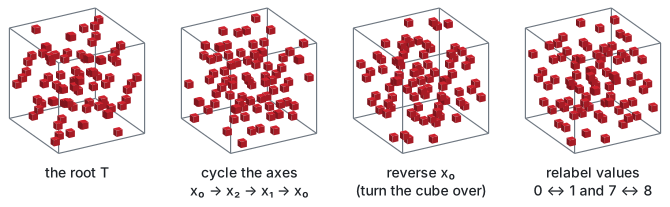
Pick a symmetry group $G$ that acts on $[9]^3$ and maps supports to supports and roots to roots (and therefore FDLHs to FDLHs). This figure shows some of the symmetries we use:
Use $G$ to divide the supports into symmetry classes. Some of these symmetry classes will contain only roots, and the others will contain only non-roots. From each symmetry class containing roots, pick one representative root $T$.
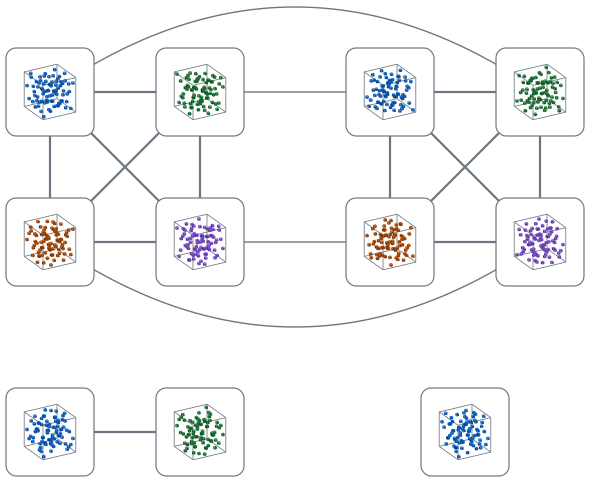
Form the graph $\Gamma(T)$ consisting of all the supports disjoint with $T$ ($T$’s companion pool). Connect two supports with an edge iff they are disjoint. This figure shows a few connected components of one $\Gamma(T)$:
Show for each such $\Gamma(T)$ that it contains no $8$-cliques (groups of $8$ vertices where every vertex is connected to every other vertex).
An order 9 fully diagonalized Latin cube, if one existed, would have a root $T = A^{-1}(A(4,4,4))$ containing its center cell, and could be transformed with a symmetry from $G$ into a fully diagonalized Latin cube $A'$ whose root $T'$ is whichever root we chose from the symmetry class containing $T$. The other eight supports $A^{-1}(\texttt{color})$ would then necessarily (i) each be disjoint with $T$ and (ii) all be pairwise disjoint, implying the existence of an $8$-clique in the graph $\Gamma(T)$. Because our enumeration shows no such $8$-cliques exist, there cannot exist a fully diagonalized Latin cube of order 9.
This is the first serious AI-assisted math result I have posted — I suppose one could count some of the exhibits in the FDLH library, but I do think there’s a big difference between uploading a modestly-sized array with a particular easily-checkable property and writing out an actual proof. I don’t think any of the proofs are ones I would totally fail to come up with if assigned them as an exercise, but figuring out exactly what group $G$ to use on my own would have been a serious puzzle — it would have taken some time for me to articulate the specific condition that $G$ ought to take supports to supports. Any desideratum I tried to articulate about the symmetry group I needed probably would imply that, but it’d be hard to state so clearly what I want. And the AI agents sort of just matter-of-factly pieced all of it together under my nose in a day or two as far as I can tell, leaving me to actually work through the precise details of their arguments over the course of weeks, though of course I didn’t spend every day focused on this particular project or anything.
Claude’s initial draft of the proof also contained a lot of ridiculously clunky parts. Several parts of it I rewrote myself entirely, or at least added a paragraph or two trying to help frame the argument better. At certain points (i.e. Lemma 5) the argument was so clunky it mostly just made my eyes glaze over; I was rather impressed with Opus 5.5’s ability to clean those parts up, even to the point where when I read through it none of the sentences really jumped out at me as needing heavy editing. I totally believe the claim that Opus 5.5’s writing is substantially better, and I think this translates to mathematical argumentation too.
I was an early tester of Opus 5.5. My biggest takeaway was that they've really fixed the writing. I haven't seen a Claude write in such a straightforward, normal, and non-slop way since at least Opus 4.6, nearly eight months ago
(Opus 5 left, Opus 5.5 right)
I’d like to think I am doing better here than outputting maths-slop, but it definitely takes a lot of curation effort and care that slows me down. If I wanted to just fire out LaTeX PDFs online as fast as I could make them, I could probably get out many results very quickly! But at least for now I am aiming to mostly put out work I can stand behind, even if parts of it are produced with AI-assistance. I do not envy the position of the mathematicians working with OpenAI22 Okay, actually, this is not true at all. I would love to know about the hundred problems that OpenAI is sitting on, and I would happily work long hours trying to help out with the “we accidentally did too much revolutionary mathematical research” problem, that sounds awesome., their job must be like what I’ve been doing here but a thousand times more complicated.
Please let me know if you find any errors in the README or code, and also feel free to ask for help if you’re trying to work through any of the mathematical arguments and are having trouble following along. Obviously at parts it gets a little technical to the point where it’ll just inevitably be hard to follow if you don’t have any group theory experience, but I tried to make it relatively accessible and would of course be happy to talk anyone through it. (And if anyone with mathematical experience is having much trouble with it, probably I didn’t do my job sufficiently well, in which case I’d like to spend another couple days cleaning up the argument).
I will probably pick back up the FDLH project more at some point, though this might be my flagship result for this particular sprint on it. There are some constructions in the FDLH library that likely deserve more detailed write-ups if I ever get to them, but really I would like to resolve the 10x10x10 question and all the other open orders. I don’t have any great leads currently, though at this rate I do have to imagine that if I don’t work anything out within the next few months, eventually the public will have access to an AI that can come up with something.
Strikingly, the graphs divide into 2048 triangle-free graphs and one exceptional graph containing eight triangles (a portion of which is shown above).
Claude could not find any particular structural reason for this value to be $2^{11}$ upon a quick investigation, and says it’s probably about a 1:100 or 1:200 coincidence. (Plus there are plenty of other values that come up over the course of the argument, so there were multiple chances to draw a coincidence). Still, I’m not entirely sure there’s nothing here. It’s certainly a delightful curiosity.
Okay, actually, this is not true at all. I would love to know about the hundred problems that OpenAI is sitting on, and I would happily work long hours trying to help out with the “we accidentally did too much revolutionary mathematical research” problem, that sounds awesome.